Saturday, July 30, 2016

CHRIST IN ME


Galatians 2:19, 20  For through the law I died to the law, so that I might live to God. 20 I have been crucified with Christ. It is no longer I who live, but Christ who lives in me. And the life I now live in the flesh I live by faith in the Son of God, who loved me and gave himself for me.

           Paul says it is impossible for a person who has been justified through faith in Christ to return to his old sinful lifestyle.  It is not merely his standing with God that has been changed.  He has been changed!  He has been united with Christ by the work of the Holy Spirit.  He now has new life.  His faith is Christ is a result of the work of God through the Son and the Spirit.

            Paul explains this new life through his own experience.  He describes it in two ways in verses 19, 20.  “I died to the law, so that I might live to God.”  “I have been crucified with Christ.  It is no longer I who live but Christ who lives in me.”  This is why Christians cannot continue to live in their sin!  Through faith in the work of Christ we have joined, by faith, in his crucifixion.  Day by day we die to sin and the old way of living.  Every day we die to our pride and our confidence in good works.  We have been united with Christ and through his Spirit he now lives in us, putting sin to death and clothing us with his righteousness.  We are being shaped into the image of Christ through death to sin and new life in Christ.  Our lives are no longer our own to live any way we please.  Christ lives in us and our lives are his to do with as he pleases.  Paul says he lives like this because Jesus “loved me and gave himself for me.”  Christ changes us spiritually.  We no longer desire to live the old way.  He puts a passion for holiness in us.  We are moving in a completely new direction, away from the old life toward God.  By grace through faith he changed us!

Friday, April 1, 2016

A SHEEP IN THE FLOCK


Psalm 23 (KJV)

The Lord is my shepherd; I shall not want.
He maketh me to lie down in green pastures: he leadeth me beside the still waters.
He restoreth my soul: he leadeth me in the paths of righteousness for his name's sake.
Yea, though I walk through the valley of the shadow of death, I will fear no evil: for thou art with me; thy rod and thy staff they comfort me.
Thou preparest a table before me in the presence of mine enemies: thou anointest my head with oil; my cup runneth over.
Surely goodness and mercy shall follow me all the days of my life: and I will dwell in the house of the Lord for ever.
 

I memorized Psalm 23 as a child.  It was so long ago that all we had was the King James Version.  (My kids figure this was sometime during the English Civil War when the KJV was still new!)  I still repeat it in the King James.  I have quoted it hundreds, maybe thousands, of times in my life.  How about you?  The same?

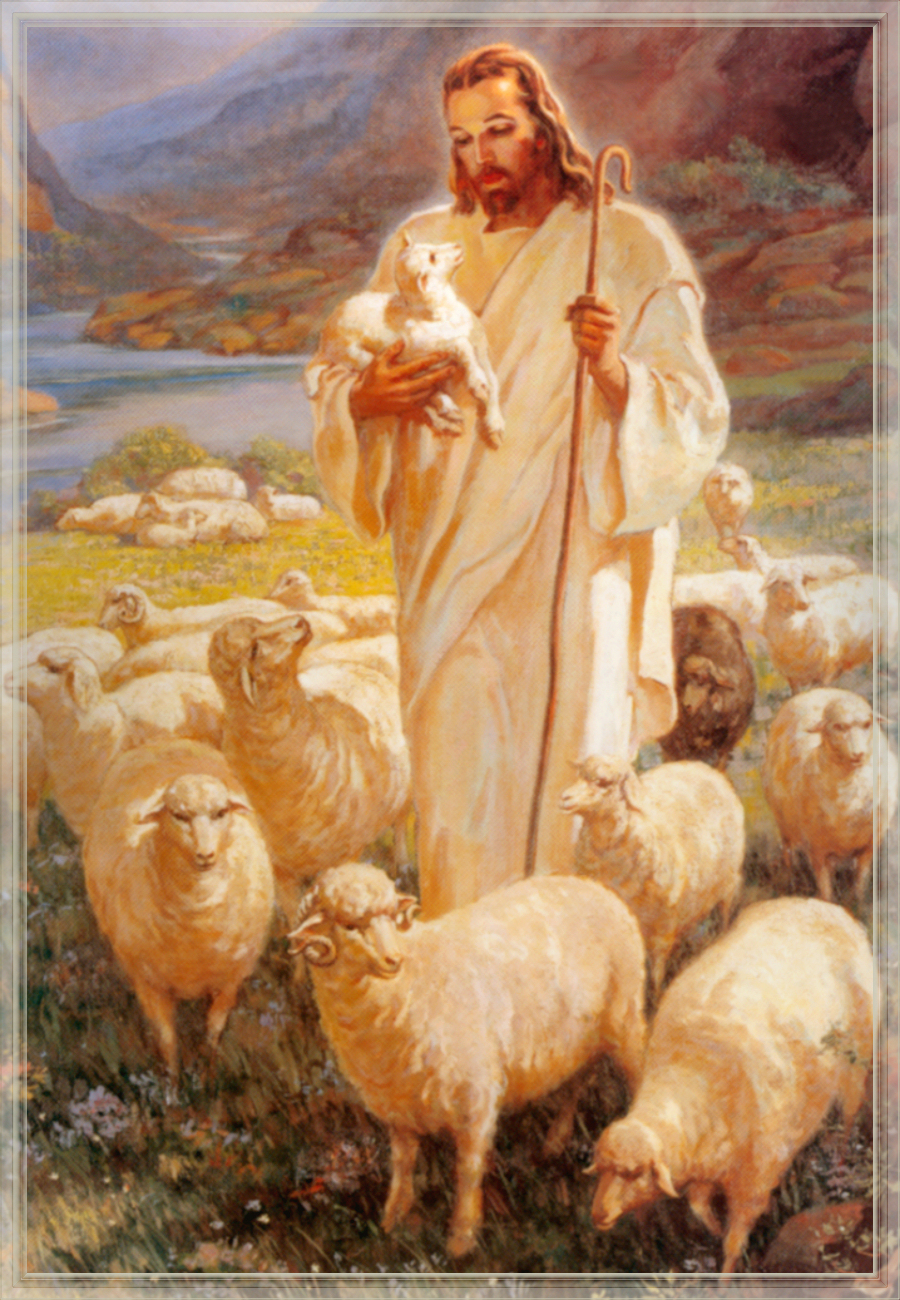
The picture above is the exact picture that hung in my Sunday School class when I was that memorizing child.  I’ve see that thousands of times too.  Very comforting. 

When I think about the psalm I think about blessings.  I will never lack any necessity.  God will provide food and drink.  He will encourage me and guide me in his ways.  He will keep me safe from attackers.  He will seat me at his banquet where I will feast with him forever.  Yes, the psalm is definitely about blessings.

The New Testament is full of shepherding word pictures.  The best known of them all is Jesus the Good Shepherd.  In John 10 Jesus compares himself, the Good Shepherd, with the hired men who run at the first sign of danger.  He knows his sheep and his sheep know him.  He calls his sheep to follow him and he lays down his life for his sheep.  There is the beloved parable about the shepherd who leaves his ninety-nine sheep in order to go looking for his one lost sheep.  What a blessing it is that I can count myself among the Lord’s sheep and trust in him for all these blessings!

But that isn’t what I was thinking about.  I was praying through Psalm 23 recently and there was a clang against my brain that pointed out something to me I had never before considered.  I know I am one of the Lord’s sheep…but how did I become part of that flock?  How did he become my shepherd?  In all my reading in the Bible I never saw a reference anywhere that talks about the sheep choosing their shepherds!  Sheep don’t choose.  They only follow the shepherd to whom they belong!  How did I net end up in another flock?

Once again I was overwhelmed by the grace of God!  He chose me to be part of his flock!  His Son, the Good Shepherd, laid down his life for me and paid the price to own me as his sheep.  He made me one of his own apart from any value or beauty in me.  Just the fact that I can say, “The Lord is my Shepherd, I shall not want,” proves to me again the sovereign grace of God.


Tuesday, February 23, 2016

WISE AS SERPENTS...


Colossians 2:8  See to it that no one takes you captive by philosophy and empty deceit, according to human tradition, according to the elemental spirits of the world, and not according to Christ.

In Matthew 10 we have the account of Jesus sending out the Twelve disciples to proclaim that the kingdom of heaven had come.  He gives them their instructions and in these instructions is one that always used to make me scratch my head.  In Matthew 10:16 he says, “Behold, I am sending you out as sheep in the midst of wolves, so be wise as serpents and innocent as doves.”  Wise as serpents and innocent as doves?  It almost strikes me as two opposite instructions.  First, be street smart about everything; alert and not easily deceived.  Second, don’t get involved in the street stuff; the sin and worldliness.

This morning in my reading I came across Colossians 2:8.  I never put these two passages together in my mind before but it seems as if Paul is encouraging the believers in the same way that Jesus charged his disciples.  “See to it that no one takes you captive by philosophy and empty deceit, according to human tradition, according to the elemental spirits of the world…”  Be wise as serpents, be alert, don’t be deceived.  “…And not according to Christ.”  Live your lives according to Christ in obedience and holiness.

I sit early in the morning and have coffee with guys from church and we have run up against this question many times.  How do we live our lives in this culture without being deceived and how do we continue faithfully demonstrating the love of Christ?  Our culture is pressing against our Christian faith all the time.  The pressure is to conform to the viewpoints and perspectives of the world.  Our schools are teaching a godless version of the origin of all things.  The environmental movement is pushing us toward worship of the earth rather than stewardship of it.  Government is threatening us with hate speech when we preach and teach a biblical view of sexuality and marriage.  More and more we are being groomed to accept the intrusion of the state into our lives while they promise they are only looking out for our good.  All of these things and many more are quietly intruding, slowly but surely leading even Christian people astray, away from the teaching of Jesus Christ.

Paul says these are human philosophies and empty deceits.  The rise from the elemental spirits of the world; i.e. the fallen human flesh.  Christians are tempted to compromise.  We are condemned because we will not accept a relativistic perspective on the philosophies of the world.  This is why we must be faithful students of the Bible.  This is why we can’t give in to those who say the Bible is no longer relevant.  This is why we must reject the popular idea that theology and doctrine are divisive and unnecessary in our churches.  If anything, we need theology and doctrine more than ever!  If we don’t hold fast to the teachings of Jesus we will surely fall into the quagmire of this world and lose hold of the truth.

Monday, February 22, 2016

SIMPLE WITNESS


John 9

Jesus and his disciples passed a blind man and the disciples sought to enter into a theological discussion with Jesus.  “Rabbi, who sinned, this man or his parents, that he was born blind?”  Jesus refused either option and replied, “It was not that is man sinned, or his parents, but that the works of God might be displayed in him.”  In other words, God ordained that the man would be born blind so God would be glorified in his life.  Jesus applies mud to the man’s eyes and sends him to wash in the pool of Siloam.  The man obeys and receives his sight.

Having nothing else to do, the seeing man returns home and his neighbors were completely befuddled.  They asked him how he received his sight and the man answered, “The man called Jesus made mud and anointed my eyes and said to me, ‘Go to Siloam and wash.’ So I went and washed and received my sight.”

The neighbors figured something religious must have taken place so they took the seeing man to the Pharisees.  The religious leaders then inquired about his sight and the man replied, “He put mud on my eyes, and I washed, and I see.”

Doubting the story of the healing, the Jews called on the man’s parents who were intimidated and would only say that the man was indeed their son.  So the Pharisees recalled the healed man and tried to drag him into a theological debate with them.  “We know that this man is a sinner.” 

The man answered, “Whether he is a sinner I do not know.  One thing I do know, that though I was blind, now I see.”

“What did he do to you?  How did he open your eyes?

“I have told you already, and you would not listen.  Why do you want to hear it again?  Do you also want to become his disciples?”

The Pharisees get angry.  “You are his disciple, but we are disciples of Moses.  We know that God has spoken to Moses, but as for this man, we do not know where he comes from.”

“Why this is an amazing thing!  You do not know where he comes from, and yet he opened my eyes.  We know that God does not listen to sinners, but if anyone is a worshiper of God and does his will, God listens to him.  Never since the world began has it been heard that anyone opened the eyes of a man born blind.  If this man were not from God, he could do nothing.”

The Jewish religious leaders cast the man out of the temple.  We would say, they excommunicated him.  Jesus found him, revealed to him that he was the Messiah, and the man believed and worshiped Jesus.

Notice just a few things.  The healed man simply told people what Jesus did for him.  He did not get involved in theology or philosophy.  He merely told what Jesus did for him.  Isn’t there a lesson for us in this?  People may want to argue with us but they can never disprove what Jesus did in our lives.  We simply tell what Jesus did for us and leave it at that.  No one can disprove that!

No fear.  The man knew what happened to him and nothing the authorities could do would change that.  Even though his parents were afraid, the man stood boldly and clung to the truth.  When God is on our side, of whom shall we be afraid?

Finally, faith and worship.  He believed Jesus.  He worshiped him.  Not complicated.  Simple!

Wednesday, February 17, 2016

MORE MAJESTIC THAN THE MOUNTAINS


Psalm 76:4  “Glorious are you, more majestic than the mountains…”

I read this psalm this morning and this phrase of the psalmist, Asaph in this case, caused me pause.  In our vernacular, Asaph is saying, “Lord!  You are so awesome!  You are more awesome than the mountains!”  For some reason my first thought was, “Huh!  That’s kind of an odd thing to say!”  Then I began to reflect…

I live in the south part of California’s great San Joaquin Valley.  We are surrounded by mountains on three sides, South (Tehachapi Mountains), East (Sierra Nevadas), and West (Southern Coastal Range).  The problem is that we don’t get to see them very often.  Our skies are generally hazy or foggy or dirty and the mountains are obscured.  But some days I get out early and the sky is crystal clear and I feel like I can almost reach out and touch the mountains.  It is inspiring!  They are so beautiful that they fill my heart with joy.  Maybe that is what Asaph had in mind?  I can’t remember one time thinking, “God!  You are more beautiful than these mountains.”  That’s when I realized that something is wrong.

A number of years ago my wife and I went on vacation to Door County, Wisconsin (pictured above) with another couple from church.  The guy we were with, Chris, got his degree in Forestry and he was a well of information on the trees and geography we found there.  Chris was constantly pointing out how beautiful everything around us was.  At some point we started saying to each other, “God made that!  And God made that too!”  It turned out to be a fantastic trip because we were always reminding each other about the glories and beauties of the Lord.

My Grandfather Moorhead also contributed something like this to me.  I remember very well his habit of drawing my attention back to God.  I might admire the beauty or the majesty of something in nature and Grandpa would always say something like, “If you think that is beautiful, just think how beautiful God is!  He thought it up and then he created it!”

I think it’s time for me to draw stronger connections between the beautiful creation that surrounds me here in California and the One who made it.  It’s time for me to carefully and consciously give glory to God and take a moment to worship him because he is surely more majestic than the things he has made.  They are but a reflection of him.

One more thing.  This creation is fallen because of man’s sin.  St. Paul reminds us that all creation is groaning to be released from the bondage that has fallen upon it.  The mountains, the rivers, and the trees long for the appearing of the Son of God.  Oh my!  Think about how beautiful it will all be in the new heavens and the new earth!  It’s beyond imagination!

Friday, February 12, 2016

SAVE ME, O GOD!


Psalm 69:6   Let not those who hope in you be put to shame through me, O Lord GOD of hosts; let not those who seek you be brought to dishonor through me, O God of Israel.
 
I came across Psalm 69 in my devotional reading recently and this verse has stuck in my head ever since.  The Hebrew psalter attributes the psalm to David.  There were a number of times in David’s life when he felt overwhelmed by his enemies.  The first four verses of the psalm describe a sense of almost desperation on his part.  He is overwhelmed.  He is weary.  He is surrounded by people who hate him and who do not serve God.  He does not depend on himself but waits for God even though he feels his strength fading.

Have we ever felt like this?  We probably all have to some degree.  I know people whose families cause them so much spiritual pain that they feel crushed by the opposition.  Others are swamped by difficulties and trials because of circumstances.  Ours are lives of struggle and troubles.

Then the psalmist confesses his own sin in verse five, “O God, you know my folly; the wrongs I have done are not hidden from you.”  He does not think he is blameless.  He does not take a high position and act like he has done nothing wrong.  He is very aware of his sin and his failure and he knows it does no good to try to hide them from God because he sees everything.  It is good for us to have a realistic and honest view of our own sin and we cannot have an honest relationship with God unless we are willing to confess it.

Then we come to verse six and this is the one that really struck me.  The psalmist is aware that his life has an effect on the people of God around him.  It seems like he is aware that they are watching him.  Perhaps he sees himself as a leader who is setting the course for God’s people.  Aware of his own sinful failures, he cries out to God to hold him up lest ongoing failures drag down the people who look to him.  Maybe he knows that if he continues to fall short then his own failures will be thrown into the face of other believers and they will suffer shame and dishonor.

We know that the sins of all believers contribute to the burden of the body of Christ.  All of our sins hinder the work we have been called to do together.  But pastors and church leaders must recognize that they bear great responsibility because they are the ones from whom much is expected by the people of the world.  We must keep in mind that not only are the people in our fellowship looking to us for leadership but the critics of the church will gleefully celebrate our failures and use them to bring shame and dishonor against our brothers and sisters.  May we humbly stay before the face of God and live our lives transparently and authentically as witnesses to God’s truth!

Thursday, February 4, 2016

ONE THING I ASK OF THE LORD


Psalm 27

This morning I was meditating on Psalm 27.  The psalmist compares the power of God and the protection God gives him to the attacks his enemies bring against him.  He speaks of the comforts God offers and shares the desires of his own heart.  We can read this psalm historically; i.e. we can see how David felt and acted when he was under attack.  We can also read this psalm instructionally; i.e. how God’s people can feel protected in the face of persecution.  This morning I read Psalm 27 spiritually; i.e. I have a spiritual Enemy who is constantly plotting against me, seeking to bring me down, and trying to keep me from rejoicing in my God.  As I meditated on the psalm I focused my attention on specific nouns and verbs.  I considered the words that relate to God’s actions toward me, his child and compared them to the words that describe my Enemy’s efforts against me.  Then I thought about how these truths work in my heart and bring about the kind of joy and celebration that honors God.  If you have time, open your Bible to Psalm 27 and follow along.

Verses 1-3.  God is Light, Salvation, Stronghold.  Since this is true I need not fear the Enemy.  My Enemy advances against me, seeks to devour, attacks, besieges, and makes war.  God makes them stumble and fall so I have no fear and I have reason to be confident in God.  He shines his light into the darkness that surrounds the Enemy so I can see my way.  He reaches down and surrounds me with his salvation so I cannot be harmed and then brings me into his stronghold where no enemy can reach me.  At one time the warfare that raged around me caused me to stumble and fall but now I see God’s light and the enemies are the ones who break themselves against the walls of his holy stronghold!  Confidence comes from feeling God’s strength and protection, not my own!

Verses 4-6.  In light of what God does for me I ask God for the following:  may I dwell, gaze, and seek.  These are words of relationship and communion.  It helps me to think of these things as they relate to human relationships.  When I began to love my wife I wanted to be with her, and look into her eyes, and seek a deeper love and commitment.  Most of my children have moved out of my house and I can hardly wait for the times they come to visit so I can be with them and enjoy them and build fresh relationships with them.  So it is with the God who loves me.  I want to be with him and stand in wonder of his glory and seek to know him better.

That kind of relationship changes my perspective on the times of trouble (v.5).  He keeps me safe, hides me, and sets me above danger.  When my grandson comes to visit, sometimes our dogs crowd around him and because he is so little and such a new walker I have to sweep him up in my arms so he won’t be overwhelmed and trampled.  I keep him above the fray of the excited dogs.  This is the picture I have of God lifting me above the destruction of the Enemy.  He keeps my head above the confusion and the danger of the Enemy’s attacks (v. 6).

All of this leads to worship (v. 6).  Sacrifice, shouts of joy, singing, and music.  Everything God does for me is meant to lead me to acts of worship that bring glory to him.  I want to be careful not to stop short of worship because that is why God redeemed me in the first place!